
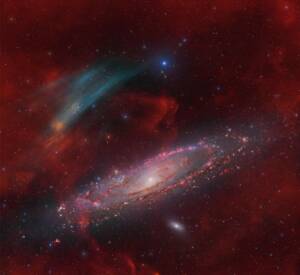
Discovery of the M31 [OIII] emission arc
Recently, a major discovery by an international team of amateur astronomers and scientists has become a huge online hit, and this new discovery is just located in one of the

For most of my life, astronomy has been a quiet constant. Telescopes have changed. Cameras have changed. Software has changed. But the act itself has not. You step outside. You look up. You try to understand what you are seeing, and if you are an astrophotographer, you try to record it with some measure of honesty.
When we talk about women in astrophotography today, we are not talking about something new. We are talking about something that has always been there, even if it was not always properly credited.
Long before any of us were arguing about back focus spacing or sensor tilt, women were doing the careful, methodical work that shaped modern astronomy. Caroline Herschel was discovering comets in the eighteenth century, not as a hobbyist with spare time, but as a working observer who cataloged the sky with discipline. Henrietta Leavitt was studying Cepheid variable stars and uncovering the relationship between their brightness and period, which became one of the foundational tools for measuring cosmic distance. Without her work, Edwin Hubble would not have had the ladder he needed to demonstrate that the universe extends beyond the Milky Way.
Annie Jump Cannon classified hundreds of thousands of stars and refined the spectral system that we still reference today. Cecilia Payne demonstrated that stars are composed primarily of hydrogen and helium, a conclusion that reshaped astrophysics. Vera Rubin provided the observational evidence that forced the scientific community to confront dark matter as a serious concept. Nancy Grace Roman helped lay the groundwork for space-based observatories, and today her name is attached to the next generation of wide field space telescope that will build on the work of Hubble and Webb.
These are not footnotes. These are pillars.
Their influence does not stop at theory. It flows down into the hardware and software we use in our backyards. The way we measure stellar brightness, the way we calibrate photometric data, the way we think about redshift and galactic structure, all of that informs the filters in your wheel, the calibration frames in your workflow, and the data processing algorithms inside modern imaging software. When you stretch a faint galaxy and reveal structure in its arms, you are leaning on a century of astrophysics that includes the work of women who were often working without recognition at the time.
Today, the landscape looks different. We have cooled CMOS sensors, harmonic drive mounts, compact refractors with near perfect color correction, and software that can guide, plate solve, and autofocus while we sit in a folding chair. The barrier to entry is lower in some ways and steeper in others. The gear is more capable, but the sky is brighter in many places. The learning curve is still real.

What has not changed is that astronomy rewards patience and attention to detail. It rewards people who are willing to learn, fail, adjust, and try again.
In this feature, I sat down with two women who represent different paths into the same sky. Luca Bartek came to astrophotography from a technical background, moving from visual observing under city skies to hauling equipment into the mountains of Switzerland in search of darker horizons. Ashley Northcotte stepped into the hobby through the growth of Astrobackyard, building her own voice in dark sky advocacy and education while learning the craft from the ground up in Ontario, Canada.
Both of them are part of a long lineage, whether they set out to be or not. The night sky does not care who is operating the mount. The photons do not discriminate. But the community does benefit when more voices are present, when more perspectives are shared, and when the work of those who came before is remembered.
Women in astrophotography are not a trend. They are a continuation. The same careful observation that defined Leavitt’s notebooks and Rubin’s rotation curves now lives in backyard observatories, portable rigs at star parties, and even in compact smart telescopes running on a patio.
The equipment may be smaller. The sensors may be more sensitive. The data may be cleaner. But the work is the same. Look carefully. Measure honestly. Share what you find.
The first woman I spoke with was Luca Bartek, ahem – aka The Space Koala

When I asked Luca how she got started, she did not hesitate.
“The question of how I got started depends on how you look at it,” she told me. “I was super interested in space ever since I can remember when I was a little girl. My parents bought me books and took me to outreach events. But I never got my own telescope until I was grown up practically.”
That telescope came in 2020.
“I was like, you know what, I have my big girl job now, I can buy a telescope, so I did.”
Her first instrument was a Celestron C9.25 on a NexStar mount. She laughed when she explained her reasoning.
“My thinking at the time was, if I buy the really big stuff now, then I will never have to spend any more money on it later on. This is just so funny to think about because we all know how it works.”
Most of us have said something similar at one point. The idea that one telescope will be enough is usually the first lesson the hobby corrects.
At that stage she had no intention of doing astrophotography.
“I had zero intention of going into astrophotography. I didn’t know the first thing about it. The idea was just to look at stuff.”
Living in the city shaped her expectations. From her location she could see the Moon, the planets, and maybe a globular cluster.
“What I could see was pretty much the Moon and the planets. Maybe some globular cluster if I was lucky, but really not much else.”
Then she started reading forums. She saw what others were producing.
“I started seeing that people were taking all these pictures and you could see so much stuff and you could see color.”
Like many of us, curiosity turned into experimentation.
“I started out in a very basic way. I had my alt-az mount and I put my mirrorless camera on it. Then I got my first equatorial mount and from that point on there was no going back.”
Today she still does some visual observing and even owns a large Dobsonian, but she told me plainly, “Ninety percent of what I do is astrophotography now.”

When I asked her about the biggest hurdle in astrophotography, I expected to hear about processing software or guiding.
Her answer surprised me.
“I really have to say it would be the light pollution situation because for the longest time I was in denial about it.”
Her home location is Bortle 7.
“When I started out, I was fully convinced it must have been like a Bortle 5 because I figured it can’t be so bad. I can see the stars.”
That optimism is common. We want our backyard to be good enough.
She kept shooting from home for years.
“My reasoning was, if I’m at home I can shoot every single clear night and then go to work the next day versus going out in the mountains which is a larger thing.”
Eventually she compared results.
“Even in narrowband, the amount of difference that it makes to go under dark skies, I decided to accept the reality that it makes zero sense to shoot from home.”
Accepting that reality meant more effort. She now travels into the Swiss mountains, imaging between 1500 and 2000 meters above sea level. Her darker site is Bortle 4.
“I love the fact that you assume my dark sky is a Bortle 1. There’s no Bortle 1 in Europe. My dark sky is a Bortle 4. And I know that doesn’t sound dark, but Bortle 4 is dark.”
She is also part of Dark Sky Switzerland and told me about a single light near her mountain site that was causing problems.
“I reached out to them and they told me exactly what to say to the owner of the light. I was expecting they would shield it. They were like, you’re right, we’re going to remove the light. I was like, you’re kidding me.”
Her conclusion was simple and practical.
“You just have to try. You don’t know if you might educate people and get lucky. You will not remove all the lights, but you can’t give up and expect people to turn them off if you don’t try.”
That is not romantic. It is realistic.
Luca works in IT within the banking sector. Her academic background is chemistry, but her career has been technical.
She joked about the overlap in our hobby.
“I have this friend who has this theory that the overlap of astrophotographers and IT people, the Venn diagram is just a circle.”
There is something to that. Astrophotography demands patience and troubleshooting.
“It takes a certain type of person to have this interest and to enjoy that kind of nerdy stuff,” she said, smiling.
It also takes grit. Equipment fails. Weather changes. Software misbehaves. The sky does not care about your schedule.
When I asked her about her favorite equipment, she hesitated because like many of us she has more than one answer.
“If I had to point out one, it would be my Newtonian, 250 millimeters. It’s just excellent. The pictures turn out well every time.”
She also has an EdgeHD 11 that holds years of memories.
On cameras, she prefers mono.
“My go to one is the 6200MM. I am very big on mono cameras, so almost always I use my mono cameras.”
She has also been using the 2600MM Air version.
“It’s just so convenient. At the beginning I was skeptical about the guiding, but I found some good strategies to make it work. Now I take that one to travel every time because it’s all in one.”
Her most memorable sky was not in Europe.
“The most beautiful and the darkest sky I’ve ever seen was actually in the United States,” she told me, describing a trip near Bryce Canyon.
“It was maybe two or three days before the full Moon. I set my alarm to like four in the morning when the Moon was supposed to set. And I’m telling you, the sky came to life.”
That was her first Bortle 1 experience.
“It wasn’t dark because there was a Milky Way that was emitting so much light. That was an incredible experience.”
There is no exaggeration in that. Anyone who has stood under a true dark sky knows the difference.

Luca captured this image of the Witch Head Nebula (IC 2118) from Switzerland over six nights between November 1 and November 6, 2024, accumulating a total of 25.3 hours of integration time. She used an Askar FRA600 paired with a ZWO ASI2600MM Pro on a ZWO AM5 mount, building the image through a full LRGB set along with 7nm H alpha data using 36 mm ZWO filters. The result reflects a methodical, mono workflow and a deliberate investment of time under clear skies, letting depth and structure emerge through patience rather than shortcuts.
We discussed smart telescopes, a topic that tends to divide people.
Luca’s view was clear.
“I am a huge fan of smart telescopes as a concept, not necessarily for me using them for my own astrophotography, but as a tool for people out there.”
She dislikes the negativity around them.
“You buy a box for a couple hundred dollars and if it goes well on the very first day you come home with a picture. Back in the day it wasn’t that easy.”
She sees them as entry points, not replacements.
“There are certain limitations set by physics simply. Those smart telescopes will never be able to produce the same pictures that we can with a large reflector.”
Her stance is measured. Encourage access. Understand limits.
When I asked her directly about being a woman in astrophotography, she answered without defensiveness.
“I cannot deny the fact that ninety something percent of this hobby is men.”
But she also pointed out something that should be obvious.
“When somebody points out, wow you’re a girl with a telescope, I’m puzzled by this whole thing because there’s absolutely nothing masculine about it.”
She continued.
“When you think about the type of things we tend to focus on, obsessing over having pretty stars and nice colors, there’s nothing inherently masculine about it.”
She has received occasional negative comments online.
“Every once in a while you get the odd sexist comment for no reason whatsoever. But everyone who puts their work out there will at some point receive negativity.”
That is the key.
“My content It has nothing to do with the fact that I’m a girl. I prefer that not to be the focus at all, I want people to like my work for the added value and the effort I put in.”
From my perspective, the sky does not respond differently based on who is operating the mount. The data either supports your processing choices or it does not. The tracking either holds or it does not.

I met Ashley Northcotte through the work she does with Astrobackyard, alongside her husband Trevor Jones. If you have spent any time on Astrobackyard.com or the YouTube channel, you have seen their style. Practical. Calm. Useful. They show what they are doing, they explain it in plain language, and they make the hobby feel approachable without pretending it is effortless.
Ashley told me her path into astronomy was not the usual story of a childhood telescope and a lifelong obsession that never let go. She came into it through the person she built a life with.
“I came into astronomy in a very nontraditional way,” she said. “My husband actually started in the hobby as a way to escape his desk job and started learning and documenting and ended up creating a website and YouTube channel.”
What stood out to me was how naturally she described the early phase. She was not trying to become an astrophotographer. She was living alongside someone who was becoming one, and she absorbed the hobby through proximity.
“Through his learning process, he shared a lot of that with me, and I absorbed it through our conversations and things together.”
Then the hobby became a business, and the business needed help.
“Eventually, that website and YouTube channel grew to the point where he needed help, someone to help out with writing content and helping run things.”
Ashley made a decision that takes more nerve than people give it credit for. She left her full time work and stepped into something unfamiliar.
“I quit my full time job, which at the time was doing educational programming in waste management. So my background was typically very educational heavy and in the environmental sector. But I decided to take a chance and make a change and started working with him full time.”
Then came the part that I respected the most, because it shows ownership. She did not just become support staff for a channel about astronomy. She decided she needed to understand the hobby on her own terms.
“Once I joined, I realized that if I was going to be a part of this, if this was going to be my new field, [astrophotography and astronomy], then I should probably know a little bit about the hobbies. So I started my own journey and learning the process of taking pictures with a DSLR and a telescope – the meaningful hands on experience and fully engaging in that work.”
She started that learning process in 2021. She and Trevor are based in Ontario, Canada.
When I asked about her biggest challenge, Ashley did not pretend she breezed through it. She described what beginners usually feel but rarely admit once they become competent.
“Early on, the learning curve, it’s very intimidating because there is the gear side, but there’s also the post processing side. So it can feel really overwhelming when you start.”
She framed the early struggle in a way that sounded like lived experience, not something repeated from a forum thread.
“If one thing doesn’t work, then your night is ruined and you have to start troubleshooting to figure out where things went wrong.”
Over time she built a system for setup. The gear got easier. The next challenge stayed.
“Once I got that part down and built my own systematic way of setting things up, I would say the biggest challenge that probably still remains for me is image processing and just learning the software, building a workflow that makes sense and just knowing that what I’m doing to my data is making it better, not making it worse.”
That line hit home. If you have ever reprocessed the same dataset three times and ended up with three different images, you know what she means.
Ashley also mentioned a problem that people in winter climates understand immediately.
“Particularly right now during the winter time, I don’t get out to do astrophotography a whole lot. So when the nicer weather rolls around, it can be a bit of a challenge to get that workflow of setting up my gear back down pat. If you haven’t done it in a while, you sort of forget.”
I asked her a question that always risks starting an argument. At what point does processing stop being enhancement and start being invention. She did not take the bait, and her answer was measured.
“I think that’s a hard question because at the end of the day, astrophotography is an art form, right? It’s a form of photography. It just so happens to be mixed with something scientific.”
She described the spread of styles without judging either side.
“Some people really like to play around with saturation and making their images really pop, and other people like to keep it more subdued and more natural.”
Then she put her stake in the ground.
“My style is more like subdued and natural. But that could change as my style evolves.”
On AI tools, she acknowledged the risk without making it sound like the sky is falling.
“It could end up going down a path where it becomes harder to tell what is real astrophotography, and what is AI generated. It ends up getting a little bit out of hand.”
Then she landed on the only honest answer anyone can give.
“It comes down to personal preference, I think.”

Ashley captured the Orion Nebula and the Running Man Nebula at the Winter Star Party in the Florida Keys under Bortle 3 skies, continuing her tradition of imaging winter targets from that location. Using a William Optics RedCat 61 on a ZWO AM3 mount with an ASI2600MC Air, she collected 160 three minute exposures for a total of eight hours of integration. The result reflects steady dark sky conditions, a portable wide field setup, and the kind of long, uninterrupted nights that make star parties as much about shared experience as they are about the data.
This is where Ashley’s background becomes an advantage. She did not talk about light pollution only as an astrophotography inconvenience. She talked about it as a broader environmental problem that intersects with education and public policy.
“Light pollution, it’s a shame because it causes a lot of people to not see the beauty that’s up there.”
Then she explained how it has shaped their life choices.
“We’ve moved houses three times. And each time we move, we try and get a little bit further away from the city just so we can get away from light pollution.”
Even after those moves, their skies are still not ideal.
“Right now, we’re sitting at maybe a Bortle 6. It’s still not great.”
Ashley has also made dark sky advocacy a central part of her work.
“I’ve combined my background in education and environmental science with astrophotography through dark sky advocacy.”
She has spent years in that role.
“I’ve spent probably the last four years, as an advocate and delegate with Dark Sky International.”
She connected the problem to real impacts beyond astronomy.
“As I’ve learned more about light pollution and its impacts on wildlife, ecosystems, human health, I do spend a lot of my time and energy advocating for dark skies.”
And she framed astrophotography as a tool that can help tell the story.
“Astrophotography allows us to tell that story visually of what people are missing out on.”
When I asked how light pollution shows up in the images, she stayed grounded.
“It comes down to utilizing filters for astrophotography or managing data that’s not as great. You spend more time in Photoshop correcting for those things.”
And she made a point that anyone in a bright suburb learns quickly.
“When you’re in a light polluted area you just get used to using those methods as part of your astrophotography.”
I asked if she ever feels like she is racing the problem, trying to get targets while they are still reasonably possible from home.
“When we do travel to dark skies it is a race to collect as much data as we can before we come back to our Bortle 6 skies.”
She also brought up space based satellite proposals and the lack of oversight in those discussions.
“These things are being proposed without any environmental regulation or studies or anything to show the effects that they’re going to have.”
Ashley and Trevor love to camp, and they have turned it into part of their astronomy routine.
“We love to camp. We have a little teardrop trailer that we’ve named Voyager 1. It is our space shuttle that takes us to dark skies.”
Last summer they took a long trip across Canada.
“Last summer we traveled across Canada to the east coast and we were gone for three weeks traveling in our trailer and camping at national parks and other places looking for dark skies.”
The theme is consistent. Outside is where they want to be.
Ashley likes a setup she can move easily, set up quickly, and travel with.
“I’m usually on the smaller end for gear. I like to be pretty portable, easier to travel with, easier to set up.”
Her favorites are in the William Optics RedCat lineup.
“Whether it’s the 51, the 61, those are probably two of my favorites.”
Mount choice matters too.
“Mounting that on ZWO AM3 is really nice, with the ZWO Air cameras. That’s probably the ideal setup for me.”
She described it in terms of real world use.
“Keeps it pretty light, portable, and I can really take that setup anywhere. We’ve taken it in backpacks and on an airplanes.”
On camera preference, she has kept it straightforward.
“I have actually never shot mono. At this stage in my hobby I would prefer one shot color.”
And her reasoning was not about ideology. It was about time and weather.
“We also don’t get a lot of clear sky time either. So one shot color works well for just knowing that I’ll get a complete image when the night’s done.”
She also said something that is rarely stated plainly but is almost always true.
“I am also a small woman. So I’d also have to be cautious about mounting an enormous scope on a rig all by myself.”
And she does not feel like she is missing out.
“I love the results that I get from a smaller refractor. And I don’t in any way feel like I’m missing out by not having a larger telescope.”

On smart telescopes, Ashley was direct and positive.
“I think they’re fantastic for a lot of reasons.”
She talked about outreach and live stacking.
“They’re great for clubs and outreach and being able to share the night sky with other people.”
She talked about beginners.
“They bring the learning curve down and helps beginners get started.”
And she talked about real weather. This is the kind of answer you only get from someone who actually sets up gear.
“Maybe we only have a half an hour or an hour clear sky window before we get more clouds. I’ll go fire up the Seestar and get an hour on a target.”
She also sees smart telescopes as a way for people to learn what the full rigs are doing behind the scenes.
“Once you understand that the camera, the filters, etc. are built into that scope, you have a better understanding of when you do progress to get a bigger rig.”
On remote astronomy, she refused the cheating narrative.
“I don’t think there’s one right way to do astronomy. I think all experiences are valid.”
Then she explained what she values most.
“Our preferred experience is to be out with our telescopes under the sky. Nothing beats a clear summer night that’s warm and you’re just enjoying time out under a dark sky with your rig firing away.”
She and Trevor do not currently have a scope hosted at a remote site.
“For us the most of the joy comes from us being out there.”
And she made a point that fits Astrobackyard’s identity.
“We’re the backyard astrophotography people.”
When I asked what she gets out of astrophotography, Ashley described three pieces that fit together.
First, she likes the methodical nature of it.
“There’s something satisfying to me about a very systematic way of setting up your equipment – it’s almost ritualistic in a way.”
Second, she likes the result and the ownership of it.
“Going through that whole setup, imaging all night, and then getting this image that you can look at after and say like I took that. I think that’s an incredible feeling that never really gets old.”
Third, she values the shared experience.
“Community is a huge part of my joy related to this hobby. At a star party the observing field is full of people. You’re all out there messing with your gear, getting your rigs running, you’re all looking up at the same sky. It’s just this collective experience that is really unique to this hobby.”
On the deeper perspective the night sky can bring, she kept it simple.
“Our problems don’t seem so big because we’re just such a small part of the greater universe.”
And she described what it can do for a person.
“It helps to ground you.”
Ashley did not claim that the hobby is hostile. She also did not claim it is perfectly fair. She described the subtle pressure many women feel in male dominated spaces.
“There definitely is this credibility gap.”
She talked about assumptions people can make about knowledge level and experience. She also spoke about the pressure of representation.
“If there are not a lot of women present, there can be a pressure, that your performance of reflecting on all women.”
And she named the internal part of it.
“Imposter syndrome probably is the biggest thing I feel personally as a woman in a male dominated space.”
I asked if she ever feels like she is in Trevor’s shadow, given that he started Astrobackyard first. She answered honestly and explained how she built her own lane.
“Sometimes I feel like I’ve sort of stepped into his world.”
Then she explained why dark sky advocacy matters so much to her.
“That’s why my dark sky advocacy work is so important to me because that’s more education focused and that’s my background.”
She has used that intersection to make her own path.
“Using that as an education platform for me has really been where I’ve made my own way.”
When I asked about mentorship and support, she pointed to community first. She described Astrobackyard itself as a form of mentorship for beginners, and then she mentioned a women centered community that mattered to her early on.
“When I first got started in astrophotography, I got involved with the group on Instagram called We Are Stella.” (https://www.instagram.com/we.are.stela)
She explained what it offers.
“It’s a group of women astrophotographers that all chat, help each other out, and offer advice. It’s a safe space for other women astrophotographers to ask questions without judgment.”
She also hosted a women led astrophotography event with members of that group.
“It was a women led astrophotography event. We all had our own expertise and specialties that we presented on and it was fantastic.”
When I asked about inspiration beyond her husband, Ashley mentioned several women whose work pushed her forward.
She talked about a book project.
“It’s called We Reach for the Sky.” (https://wereachforthesky.com)
And she described what it did for her.
“Just reading through that book makes me want to learn everything under the sun.”
She mentioned an early inspiration on Instagram.
“Her name’s Diana Herber. Her Instagram handle’s vanillamoon_astro.” (https://www.instagram.com/vanillamoon_astro)
Ashley described the feeling many of us have when we see a level of work we want to reach.
“If I could take something even close to her images one day, I would be so proud.”
She also mentioned a YouTube creator who helped her see what was possible.
“Helena Cochran from Helena’s Astrophotography on YouTube.” (https://www.youtube.com/@HelenasAstrophotography)
And she explained why.
“She’s a young woman who had a YouTube channel promoting astrophotography. To put yourself out there on YouTube in a male dominated hobby, I was so proud of her and I was so inspired by her.”
Then she summed up the practical value of that kind of example.
“It was an encouragement. Like I can keep going.”
When I sat down with Luca and Ashley, both accomplished astrophotographers in their own right, I did not approach the conversations as if I were interviewing “women in astronomy.” I approached them as I would any serious observer of the night sky. We talked about gear, workflow, light pollution, frustration, dark skies, community, and the quiet satisfaction of capturing something faint and distant. It was not different. It was not delicate. It was two people who care deeply about the same thing having an honest conversation.
And that is exactly how it should be.
The sky does not assign categories. It does not check credentials. It does not care who is turning the focuser or stretching the data. It rewards patience, discipline, curiosity, and persistence. Those qualities are not owned by any one group.
If this piece does anything, I hope it normalizes what should already be normal. Competent, thoughtful people standing under the same night sky, doing the same careful work, sharing what they learn. Not as exceptions. Not as symbols. Just as astrophotographers.


Recently, a major discovery by an international team of amateur astronomers and scientists has become a huge online hit, and this new discovery is just located in one of the
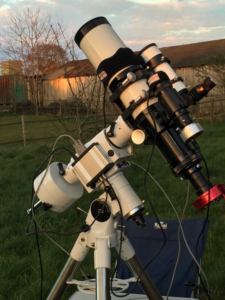
Hi, I’m Christopher Rose. My own personal interest in astronomy started when my parents got our own black and white television so we could watch the first man to land
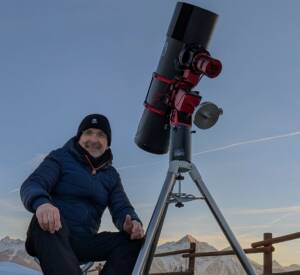
Hi, my name is Alessandro Cipolat Bares, I’m 72 years old , I live in Aosta, in the Aosta Valley, a mountainous region in the heart of the Western Alps.
My name is Julien De Winter (@dwj85), and I live in Belgium. I am a Professor of Chemistry at the University of Mons, where my research focuses on mass spectrometry
Hi! My name is Nicola Bugin and I live in a town in northern Italy called Borgoricco. I’m really happy that my photo of WR-134 has been so successful that
My name is Quentin (@_quentin_g), I am 17 years old, and I live in Nantes, in the west of France. I am currently in a French preparatory class for engineering