
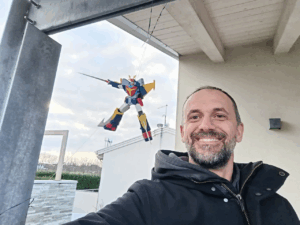
With the help of the Sun… I will win!!
by Alessandro Ravagnin Sometimes, creativity takes you to the most unexpected places. After countless classic shots of our beloved Sun, I decided to do something completely different—to create the strangest
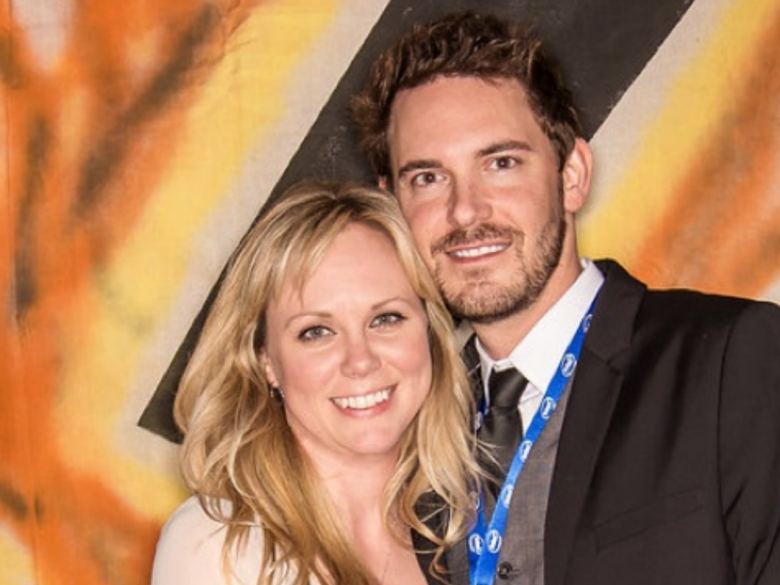
I think most astrophotographers can trace everything back to one very specific moment — that first time looking through a telescope.
For me, that moment happened when I was four or five years old. My father was passionate about astronomy, and one night he pulled out his old orange C8 and pointed it at Saturn. I climbed up on a little step stool, put my eye to the eyepiece, and there it was: a tiny, perfect world with perfect rings. I was hooked.
Fast-forward a couple decades: I was in college, I finally had my own telescope, and I could try to take pictures like the ones I’d seen in astronomy magazines for so many years. I started with my dad’s old film SLR and a newtonian. I tried photographing the Moon and mostly failed. Then I fell down the rabbit hole of early amateur digital planetary imaging — modded webcams, taped-on adapters, entire forum threads about which webcam chip had the least noise and the highest framerate. The results weren’t pretty, but they were mine, and they showed me that with a bit of stubbornness, I could capture something.
Over the following years, I’d revisit the telescope and keep trying. I pretty much stuck to lunar and planetary, since deep sky astrophotography always seemed too daunting. In 2019, I decided to bite the bullet and try deep sky imaging with a C8 on and alt/az mount, and a DSLR. It wasn’t pretty, but I was officially hooked.
And here we are today…several telescopes and ZWO cameras later, I’m constantly chasing photons that have been traveling for thousands (or millions) of years.
My setup has changed dramatically over the years — as I suspect is true for most of us.
I started with SLRs, modded webcams, and digital point-and-shoots, then got a little more serious about planetary imaging (I bought the first ever ZWO 120, packaged in a little brown cardboard box), then moved to a modified DSLR to try deep sky imaging, then finally to a cooled OSC astrophotography camera (2600MC), then to mono (2600MM). Having a cooled, mono camera with narrowband filters is the way to go if you’re imaging from the city.
My current main combo is:
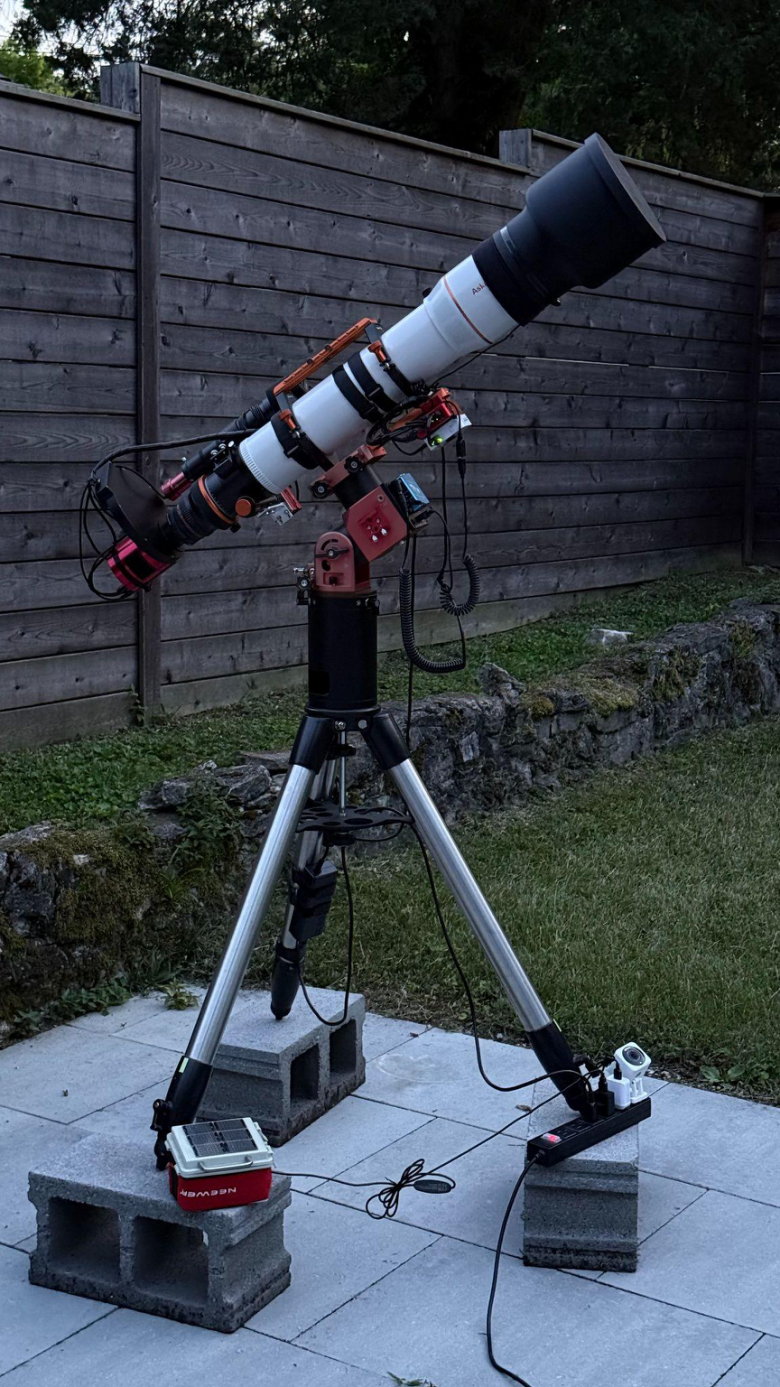
Most of my imaging happens right in my backyard in Nashville under a Bortle 8.5 sky. It’s not ideal, but narrowband filters make it possible. Imaging from such light-polluted skies means I need to do very long integrations to get the results I want. I often go a little overboard with integration time (200 hrs isn’t uncommon), but that’s how I like to do things.
My wife’s parents own a 200 acre farm in Bone Cave, TN, which is a Bortle 3-4. Whenever I get a chance to take a scope to the farm, I jump on it. Unfortunately, it’s not very often.
One of the most incredible moments I’ve had with astrophotography wasn’t a single night — it was an image that unfolded over years. The first winter I attempted the Spaghetti Nebula, I didn’t get nearly as much integration time as I hoped for. It’s such a faint target that you really only start to see good detail after many hours, and by the time winter ended, I knew I was going to have to continue the project the following winter.
When the second winter rolled around, I started planning my sessions and framing the target again. That’s when I noticed something surprising — Mars was slowly making its way toward my field of view. And there was one night where it would be perfectly opposite the bright star Alnath in my frame.
With a big stroke of luck, the night to capture mars was a clear one.
There was this moment where I sat back and thought: “Okay… this is going to be special.”
Not only was I gathering a massive integration on one of my favorite faint targets, but now I had captured a special visitor. You don’t get opportunities like that very often!
I knew I wasn’t stopping at two winters. I committed to a third winter on the same project — partly out of stubbornness, and partly because it was just too good to pass up a deep, multi-year integration on a super faint supernova remnant with Mars making a cameo appearance right where I needed it.
That combination — patience, timing, and a little bit of luck — is something that rarely seems to work out the way you want it to, but it did this time. Having the willpower to wait it out and dedicate that many clear nights to one image, to me, is quite an achievement!
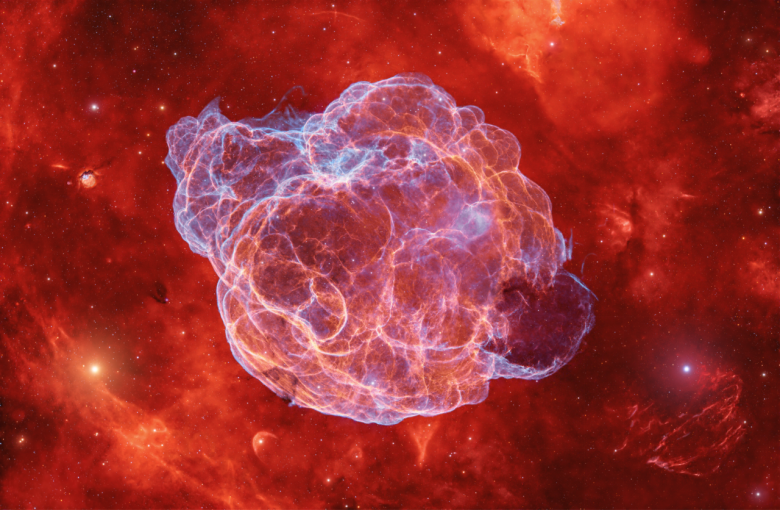
Total integration: 569h 4m 30s
Integration per filter:
R: 25m
G: 25m
B: 25m
Hα: 178h 18m
SII: 175h 53m
OIII: 213h 38m 30s
Equipment:
Telescope: Askar FMA180
Camera: ZWO ASI2600MM Pro
Mount: ZWO AM5
Filters: Antlia 3nm Narrowband H-alpha 2″, Antlia 3nm Narrowband Sulfur II 2″, Astronomik Deep-Sky Blue 2″, Astronomik Deep-Sky Green 2″, Astronomik Deep-Sky Red 2″, Chroma OIII 3nm Bandpass 2″
Accessories: ZWO ASIAIR Plus, ZWO EAF, ZWO EFW 7 x 2″
Software: Adobe Photoshop, Pleiades Astrophoto PixInsight, ZWO ASIAIR
My processing workflow is… let’s call it “iterative.” I sit down for a few hours, do a first pass, walk away, come back the next day, redo half (or all) of it, and repeat that cycle until I can look at the image for about a week without wanting to change something. Sometimes this takes a few days, sometimes it takes a few weeks. Most of my images end up having very different processing steps and techniques…it just depends on the target and the data…but I do have a general way of trying things:
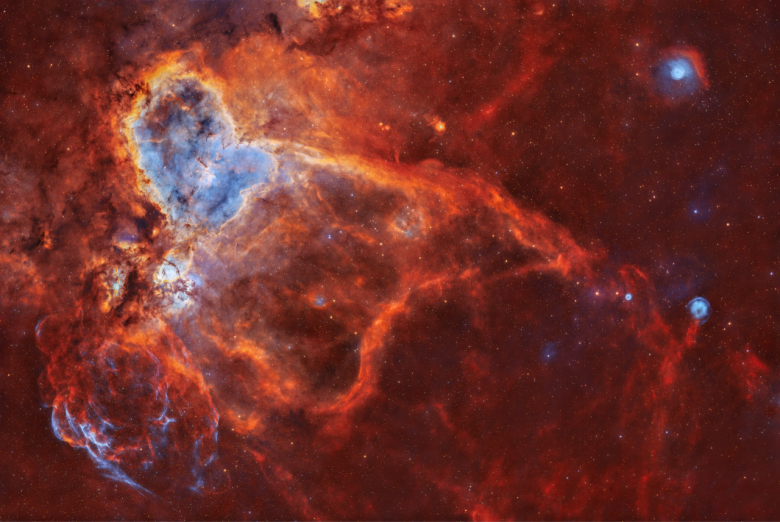
Total integration: 405h 22m
Integration per filter:
Hα: 141h 30m (1698 × 300″)
SII: 143h 52m (1079 × 480″)
OIII: 120h (720 × 600″)
Equipment:
Telescope: Askar FMA180
Camera: ZWO ASI2600MM Pro
Mount: ZWO AM5
Filters: Antlia 3nm Narrowband H-alpha 2″, Antlia 3nm Narrowband Sulfur II 2″, Chroma OIII 3nm Bandpass 2″
Accessories: ZWO ASIAIR Plus, ZWO EAF, ZWO EFW 7 x 2″
Software: Adobe Photoshop, Pleiades Astrophoto PixInsight, ZWO ASIAIR
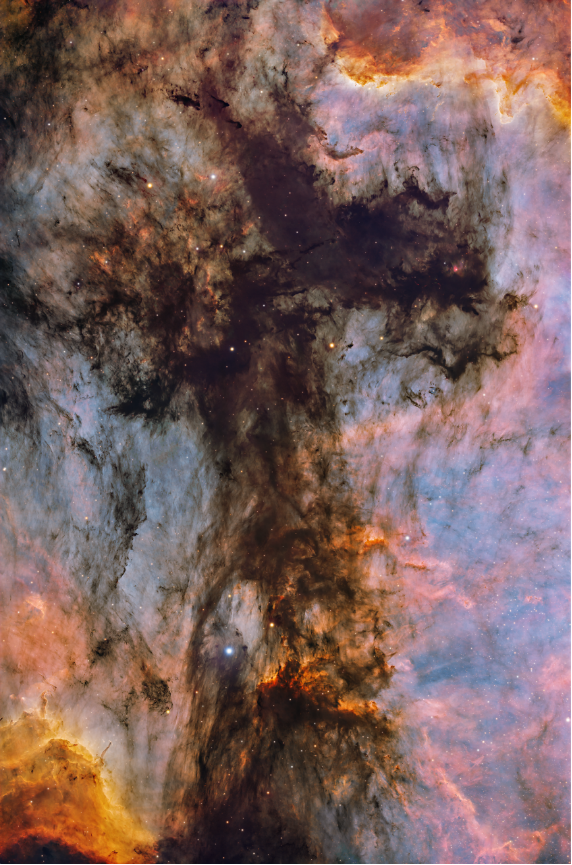
Total integration: 364h 57m
Integration per filter:
Lum/Clear: 29h 19m (1759 × 60″)
R: 10h 36m (212 × 180″)
G: 8h 39m (173 × 180″)
B: 9h 48m (196 × 180″)
Hα: 103h 30m (1242 × 300″)
SII: 101h 30m (1218 × 300″)
OIII: 101h 35m (1219 × 300″)
Equipment:
Telescope: Askar 120APO
Camera: ZWO ASI2600MM Pro
Mount: ZWO AM5
Filters: Antlia 3nm Narrowband H-alpha 2″, Antlia 3nm Narrowband Sulfur II 2″, Chroma Blue 2″, Chroma Green 2″, Chroma Lum 2″, Chroma OIII 3nm Bandpass 2″, Chroma Red 2″
Accessories: Askar 0.8x Full Frame Reducer / Flattener for 120APO Telescope, ZWO ASIAIR Plus, ZWO EAF, ZWO EFW 7 x 2″
Software: Adobe Photoshop, Aries Productions Astro Pixel Processor (APP), Pleiades Astrophoto PixInsight, ZWO ASIAIR
If I had to pick one image that I’m proud of for reasons that go beyond being a “pretty picture”… it’s Don’s Nebula.
It started as a normal deep integration from my backyard in Nashville — I was imaging wide around the Elephant Trunk region in Cepheus. I shared the finished image with my friends Drew Evans and Brian Fulda, and we noticed something that looked interesting: a tiny, faint little OIII “blob” that didn’t seem to match anything professionally cataloged. We did what all amateur astronomers do when something seems off — we checked everything, checked again, and then pulled in more eyes. With the help of a Slovenia-based imager (Jaša Rebula), we formally submitted it for review… and after months of waiting, we got the news that it was registered as a new planetary nebula candidate.
The timing of that “yes, we’re recognizing it as a planetary nebula candidate” is what made it unforgettable. My father, Don Horne, was in the hospital. I was able to tell him that this little object — found in my data — was real, that we’d helped bring something new into the world of astronomy, and that collectively we’d decided to name the nebula after him. He was too tired and weak to have the physical reaction that I knew he wanted to have, but I could tell that he was so happy and so proud. He passed away a few days later.
It’s a reminder of why I love this hobby: sure, we’re making art… but sometimes we’re also doing real exploration. And every once in a while, the universe hands you something that feels personal.
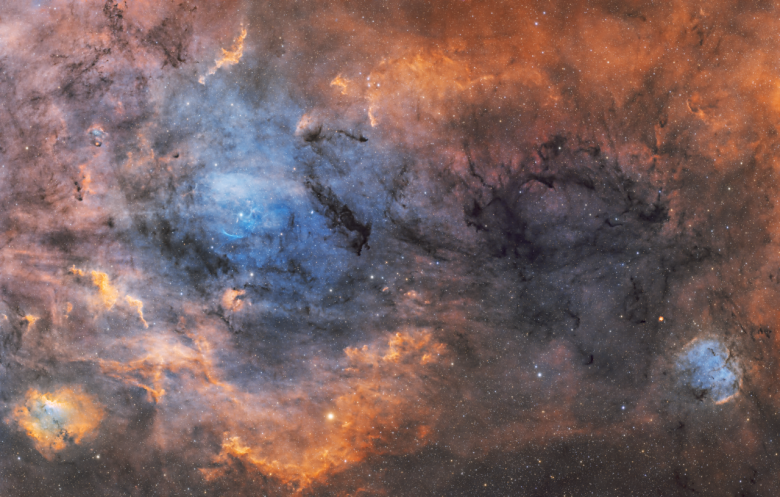
Total integration: 174h
Integration per filter:
Hα: 47h 45m (573 × 300″)
SII: 66h 50m (802 × 300″)
OIII: 59h 25m (713 × 300″)
Equipment:
Telescope: William Optics Redcat 61
Camera: ZWO ASI2600MM Pro
Mount: ZWO AM5
Filters: Antlia 3nm Narrowband H-alpha 2″, Antlia 3nm Narrowband Sulfur II 2″, Chroma OIII 3nm Bandpass 2″
Accessories: ZWO ASIAIR Plus, ZWO EAF, ZWO EFW 7 x 2″
Software: Adobe Photoshop, Pleiades Astrophoto PixInsight
Normally, I try to avoid imaging very common targets with conventional framings or compositions. I remember reading an interview with Rogelio Bernal Andreo — in which he mentioned that so many astrophotographers are each essentially taking the same photos as each other, over and over again. His advice was to get creative and try to do things differently, and that advice really stuck with me.
My wide-field projects have helped me be creative, being able to show many popular nebulae in one frame, and they’ve also acted almost like scouting missions over the years. They’ve helped me identify less-imaged structures that I think would look awesome “up close” and deep with my Askar 120 APO. I have quite a few of these images that I want to take…but I also think that there are quite a few popular targets that would look incredible with super deep integrations…like hundreds of hours.
The Soul Nebula became a bit of an experiment, to see if imaging a bright and traditional target, but going very deep, would be worth it. I got about 235 hours of integration, which is far more than most people would spend on a bright target like this. What surprised me was how much subtle structure and depth emerged as the data accumulated. The processing came naturally — the image almost seemed to process itself.
So, I plan to strike a balance: going extremely deep on a few popular targets where long integration might reveal something incredible, while also continuing to take deep integrations of some interesting lesser-known regions that have shown up in my wide-field images. There’s one particular faint and under-appreciated area in Cepheus that I’m especially excited about — it’s likely to become a full-summer project for me.
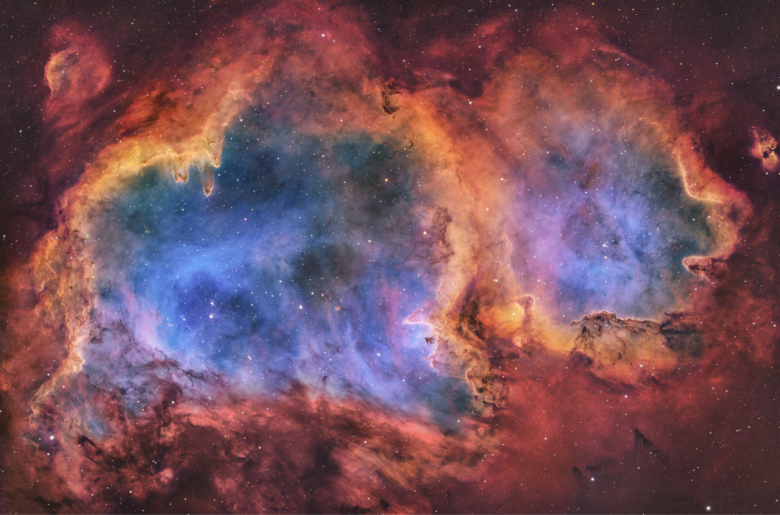
Total integration: 234h 55m
Integration per filter:
Hα: 78h 50m (946 × 300″)
SII: 79h 30m (954 × 300″)
OIII: 76h 35m (919 × 300″)
Equipment:
Telescope: Askar 120APO
Camera: ZWO ASI2600MM Pro
Mount: ZWO AM5
Filters: Antlia 3nm Narrowband H-alpha 2″, Antlia 3nm Narrowband Sulfur II 2″, Chroma OIII 3nm Bandpass 2″
Accessories: Askar 0.8x Full Frame Reducer / Flattener for 120APO Telescope, ZWO ASIAIR Plus, ZWO EAF, ZWO EFW 7 x 2″
Software: Adobe Photoshop, Aries Productions Astro Pixel Processor (APP), Pleiades Astrophoto PixInsight, ZWO ASIAIR
I first heard about ZWO back in the early days of the ASI120 camera. I saw some planetary/lunar images showing up on some forums that I used to frequent, and I knew I had to have one. That little red camera in a brown cardboard box absolutely blew my mind. I’ve been a ZWO user ever since.
The biggest difference ZWO has made in my astrophotography is removing friction in both function and price. The ASIAIR ecosystem in particular transformed my workflow from complicated to “easy.” It’s one of the few pieces of gear that genuinely makes the hobby simpler.
ZWO has always pushed the hobby forward, and I can’t wait to see where they take us next.
by Alessandro Ravagnin Sometimes, creativity takes you to the most unexpected places. After countless classic shots of our beloved Sun, I decided to do something completely different—to create the strangest
Hi everyone. My name is Alex, and I am an astrophotographer. I would like to start by thanking You for choosing my picture among all the great pictures You receive.
Why the Orion Nebula Never Gets Old – Each winter, stargazers return to this cosmic masterpiece to test new skills and relive the wonder. Explore the Orion region’s iconic nebulas,
In 1994, I built my first fully functional reflecting telescope in Hungary with my own hands. In the former Eastern Bloc countries, telescopes still could not be purchased in stores
1.How It All Began I have been a fan of astronomy since high school.Starting from a school event where I can see the moon up close through a telescope.When I