Houston, Texas, USA
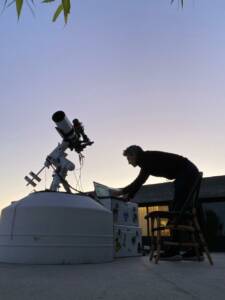
Shooting deep-sky targets from a Bortle 9 zone? Most would say it’s nearly impossible — but not Clint Shimer. Living next to a brightly lit baseball field in Houston, Texas, Clint contends with intense light pollution every night. With stadium lights glowing late into the evening, only the brightest stars are visible to the naked eye. But instead of giving up, Clint embraced the challenge with monochrome narrowband imaging — and the results are truly impressive.
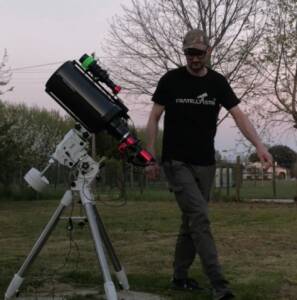
Equipped with a ZWO ASI183MM Pro, Celestron C6 Hyperstar, and an equatorial wedge mount, Clint captures hundreds of short sub-exposures (30–90 seconds) using narrowband filters at f/2. Through careful post-processing to remove heavy gradients, he brings out stunning detail in deep-sky objects — all from one of the brightest skies imaginable.
“While there is no substitute for dark skies, long-exposure astrophotography can still be done under the most extreme light-polluted conditions. This challenge is what makes this hobby exciting.” Clint said.

Meet Astrophotographer Nicola Bugin: An 8-Year Journey from a Light-Polluted Backyard to NASA APOD
Hi! My name is Nicola Bugin and I live in a town in northern Italy called Borgoricco. I’m really happy that my photo of WR-134 has been so successful that